 Degchi

When to Restock Atta, Rice and Daal: Simple Reorder Points
The empty atta tin on Friday night
You reach for the atta to make roti and the tin shows the bottom. Shops are shut, or the nearest desi store is a 25-minute drive away. Dinner becomes rice, again.
The standard advice is "keep a well-stocked pantry". It is useless on its own, because it does not tell you when to buy. The method that actually works is borrowed from shops: set a reorder point for each staple, which is the amount that still covers you while the next bag arrives.
The two numbers you need
For each staple, you need:
- Meals per bag. How many dinners does one bag give you?
- Lead time. How many days until you can actually buy more?
Reorder when the stock left covers your lead time. If your supermarket run is weekly, lead time is up to 7 days plus a buffer. If you drive an hour to a halal store once a month, your buffer is the whole gap between trips.
Work out meals per bag from the recipes
Our recipe amounts give a usable baseline. For a family of five, scale four-serving amounts by 1.25.
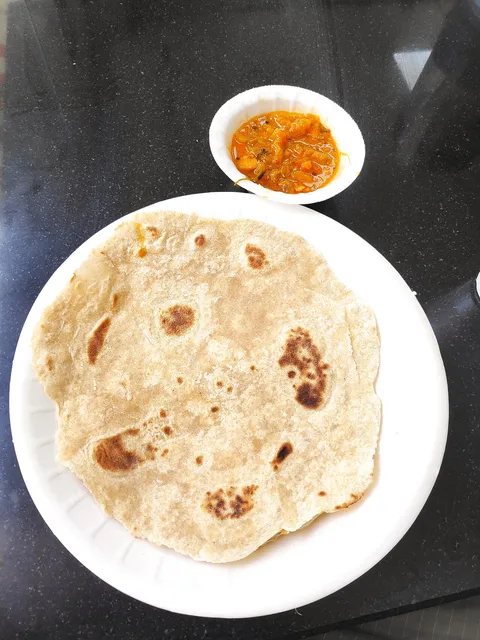
- Atta. Chapati/phulka uses 300 g (2.25 cups) of atta for 4. For five, that is about 375 g per dinner. A 5 kg (11 lb) bag gives roughly 13 roti dinners. If you eat roti five nights a week, that bag lasts under three weeks.
- Rice. Chicken pulao uses 400 g (2 cups) of basmati for 4. Five people need about 500 g. A 5 kg bag means about 10 rice dinners, around two weeks at five nights a week.
- Red lentils. Masoor daal uses 200 g for 4, so 250 g for five. A 1 kg bag is four daal dinners.
- Moong. Daal moong also uses 200 g for 4, so the same math applies.
- Khichdi. Khichdi takes 150 g rice and 150 g moong for 4. For five, that is about 190 g of each per pot.
Your own numbers will differ. Check your bag sizes, because 5 kg and 10 lb are not the same, and use the figure on your actual packet.
Calculate your reorder points
Take meals per bag and multiply by how often you cook with the staple. A worked example for atta, in a house that eats roti four nights a week and drives to the store every two weeks:
- Use per week: 4 dinners x 375 g = 1.5 kg.
- Lead time: 14 days, so 3 kg across two weeks, plus one spare dinner.
- Reorder point: when the tin or bag holds about 3.4 kg (3 kg plus the 375 g buffer) or less.
For a house that shops weekly, the reorder point is much lower: 1.5 kg plus a buffer. The result is a line you can mark on the bin with tape.
For small, fast items, count dinners instead of kilograms. If there are fewer than two daal dinners left, add daal to the list.
Mark the line physically
Numbers on a note get forgotten. A line on the container does not.
- For clear storage tubs, put a strip of masking tape at the reorder level. When the staple dips below, it goes on the list.
- For bags, fold the top at the reorder weight, or keep a spare unopened bag as your trigger: open the spare, buy another.
- Use the "two-bag rule" for staples you cannot get easily. When you open bag two, bag three goes on the list.
The two-bag rule is the simplest of all for atta, rice and the daals you use every week. You never reach zero, because the last bag you open is the reorder trigger.
Things that change the timing
A few reasons your reorder point will move.
- Guests, Ramadan, Eid. A big month can double your rice and atta use. Add a week of extra stock before it begins; see our Ramadan grocery list for a plan.
- A new cooking habit. If someone starts taking a roti lunchbox, atta use goes up by 75 g per meal for each extra person.
- Storage. Atta and rice kept in airtight containers in a cool, dry cupboard keep better than in open bags, and in humid kitchens whole grains and flours attract weevils sooner. If a bag has been open for a long time, check it.
- Sale and bulk buys. A 10 kg sack only saves money if you use it before it goes stale. Do not buy more than you can store properly.
Ground spices are the odd one out. They fade in flavour rather than run out. Buy small jars, write the date on the lid, and replace the ones you use most before they feel flat.
Pantry reorder sheet
Copy this and fill in your own numbers.
| Staple | Meals per bag | Lead time | Reorder when |
|---|---|---|---|
| Atta, 5 kg | about 13 | 7 days | under 2 kg |
| Basmati, 5 kg | about 10 | 7 days | under 1.5 kg |
| Masoor, 1 kg | 4 | 7 days | 1 dinner left |
| Moong, 1 kg | 4 | 7 days | 1 dinner left |
| Oil | by bottle | 7 days | one-third full |
Adjust the third column to your own shopping rhythm. If you shop every three weeks, double the buffer.
Let the list do the remembering
You do not need to track grams perfectly. What matters is marking the staple the moment it dips under the line, so you never rely on memory in the shop. Degchi lets you mark pantry items as Have, Low or Out, and Low or Out items go straight onto your shopping list; the try-it pantry on the home page shows how that works with no sign-up. For a weekly routine to go with this, see our ten-minute weekly pantry reset and the monthly staples run vs weekly fresh run.
Related recipes


Related posts

Monthly Staples Run vs Weekly Fresh Run: What to Buy When
Rice, lentils and spices once a month, vegetables and dairy once a week. A split shopping plan with a checklist table you can copy.

Back From a Trip: How to Restock a Desi Kitchen Without Overbuying
Coming back to an empty kitchen is tiring. Check what is safe, buy the basics first, and plan a simple first week.